The four types of telehealth
Telehealth is usually sorted into four categories. Many services combine more than one.
- Live (synchronous) video or phone visits: you and the clinician talk in real time, the way you would in an exam room.
- Store-and-forward (asynchronous) care: you submit your history, symptoms, photos or test results, and a clinician reviews them and responds later in a secure thread. Many prescription and refill services, including Plunge Care, work this way.
- Remote patient monitoring: a connected device such as a blood pressure cuff, glucose meter or scale sends readings to your care team between visits.
- Mobile health and messaging: secure portals and apps for questions, education, reminders and follow-up.
What is the main reason clinics offer telehealth visits?
Access. The single biggest reason health systems and independent clinicians offer telehealth is that it removes the barriers that stop people from getting care at all: travel time, time off work, childcare, mobility, distance from a specialist, and the simple difficulty of getting a timely appointment.
Close behind are convenience and continuity. Routine follow-ups, medication reviews and refills do not need an exam room, and moving them online frees in-person slots for people who need them. During infectious-disease seasons it also keeps contagious patients out of waiting rooms.
For patients paying out of pocket, telehealth visits are also usually priced lower than an office visit, because there is no building, front desk or exam room to pay for.
How does a telehealth call work?
A live telehealth call works like any video call, with a few health-specific steps around it. For a written, asynchronous visit the steps are similar but there is no appointment to join.
- You create an account and confirm your identity and the state you are physically in. Clinicians can only treat patients located in a state where they hold a license.
- You share your health history, current medications, allergies and the reason for the visit. Good services ask structured questions so nothing important is missed.
- You consent to telehealth. Most states, New York included, require the clinician to document that you agreed to be treated remotely.
- The visit happens: a video or phone call at a scheduled time, or a clinician reviewing your written request and replying in a secure thread with follow-up questions.
- The clinician decides. If treatment is appropriate they send a prescription to your pharmacy or order labs; if it is not, they tell you why and where to go instead.
- You get a record of the visit and a way to message with questions afterward.
How long do telehealth calls last?
A live telehealth visit for a straightforward problem typically runs ten to twenty minutes, about the same as the face-to-face portion of an office visit. New-patient visits and mental health sessions run longer, often thirty to fifty minutes.
Asynchronous visits do not have a fixed length. You spend a few minutes submitting your request, and the clinician reviews it when they pick it up. Turnaround is what matters there: Plunge Care clinicians review requests usually the same day and always within one business day, and you can message in the same thread if they need more information.
Whichever format you use, the visit should never feel rushed. A clinician who cannot get what they need from you remotely should say so and recommend an in-person evaluation.
What telehealth is good for, and what it is not
Telehealth fits well for ongoing conditions that are already diagnosed, medication reviews and refills, minor acute problems that can be assessed by history and photos, mental health follow-up, test-result reviews and questions between visits.
It is a poor fit, or unsafe, for chest pain, trouble breathing, stroke symptoms, severe bleeding, serious injuries, suicidal thoughts with a plan, or any problem that is getting worse quickly. Those need 911 or an emergency room, not a request form.
Plunge Care handles non-emergency care only. If you think you may be having an emergency, call 911 or go to the nearest emergency room.
How Plunge Care fits in
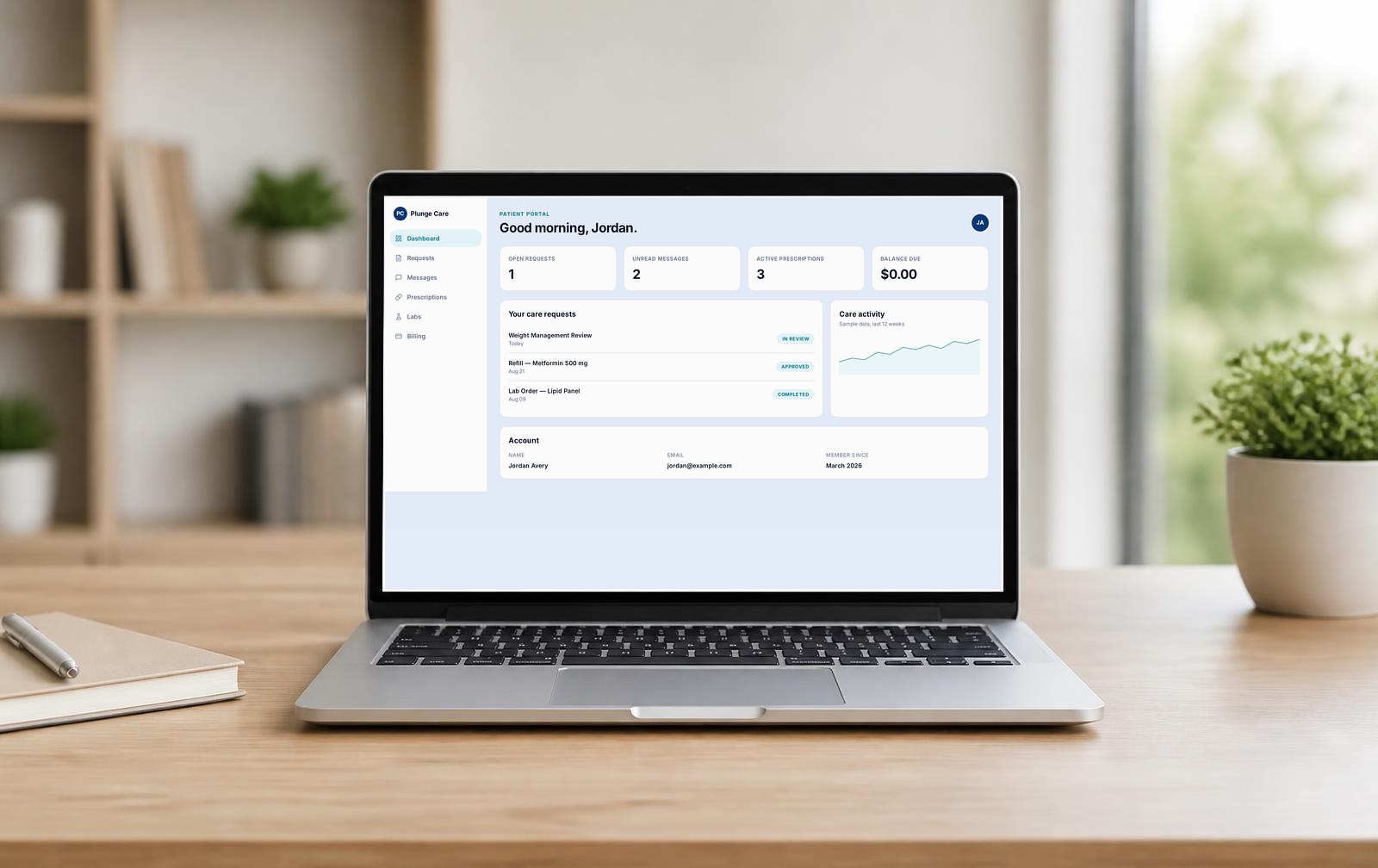
Plunge Care is a written, asynchronous telehealth service. You submit a request through a secure patient portal, a clinician licensed in your state reviews it personally, and you message with them in the same thread. There is no video appointment to schedule and no waiting room.
If the clinician decides treatment is appropriate, the prescription or lab order is sent to the pharmacy or lab you choose. If not, they tell you plainly and point you to the right kind of care. Plunge Care does not bill insurance, does not prescribe controlled substances and does not sell medication; you see the visit fee before you confirm, and nothing is charged until a clinician accepts your request.